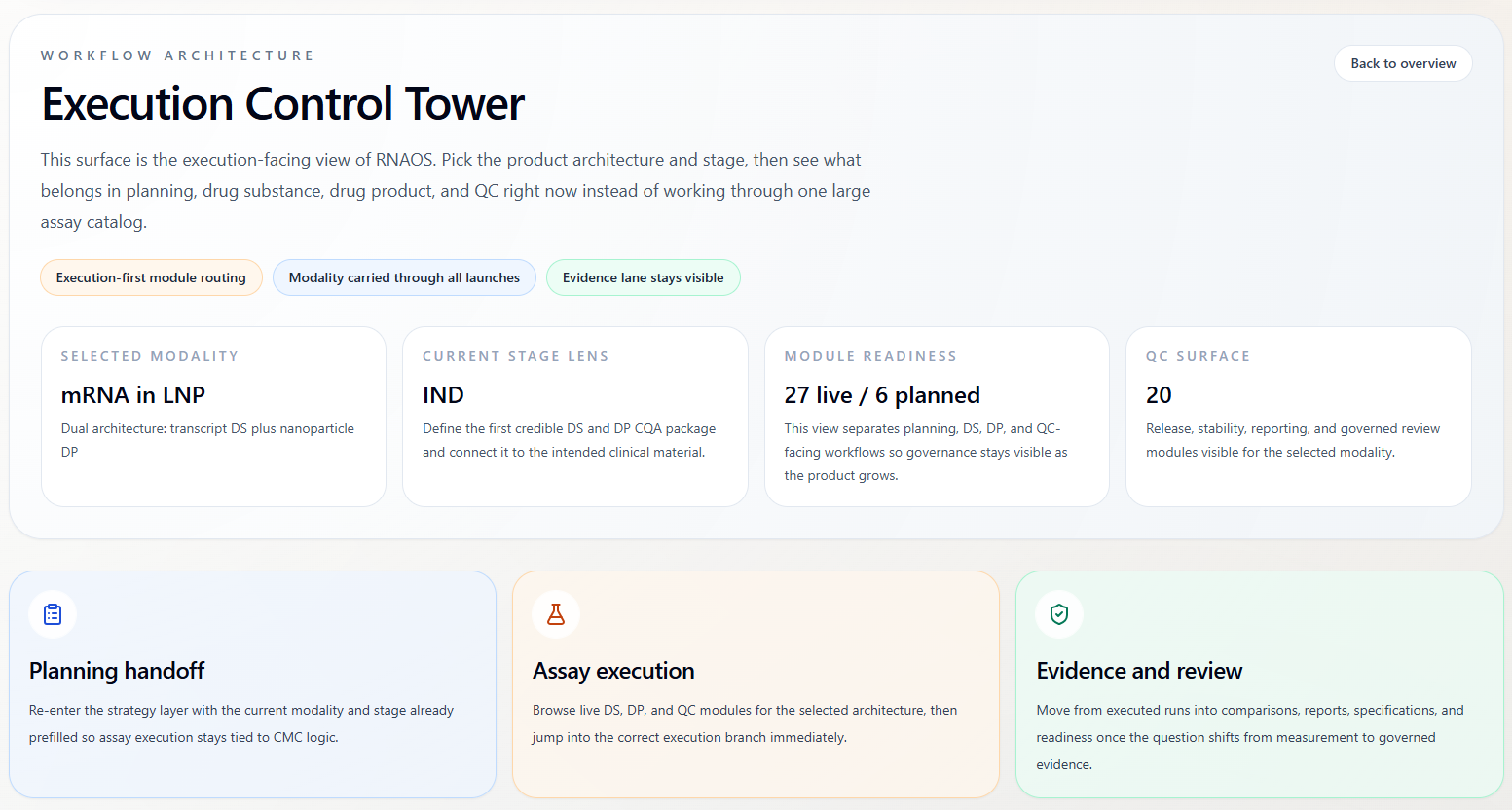
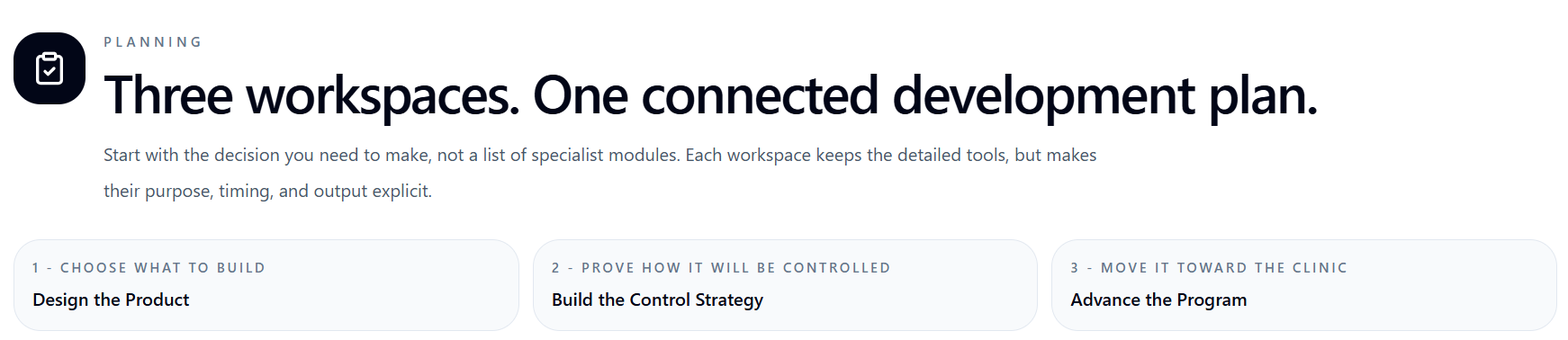
Start with the decision—not a generic assay catalogue.
RNAOS captures modality, development stage and product architecture, then connects CMC planning to the analytical work that follows.
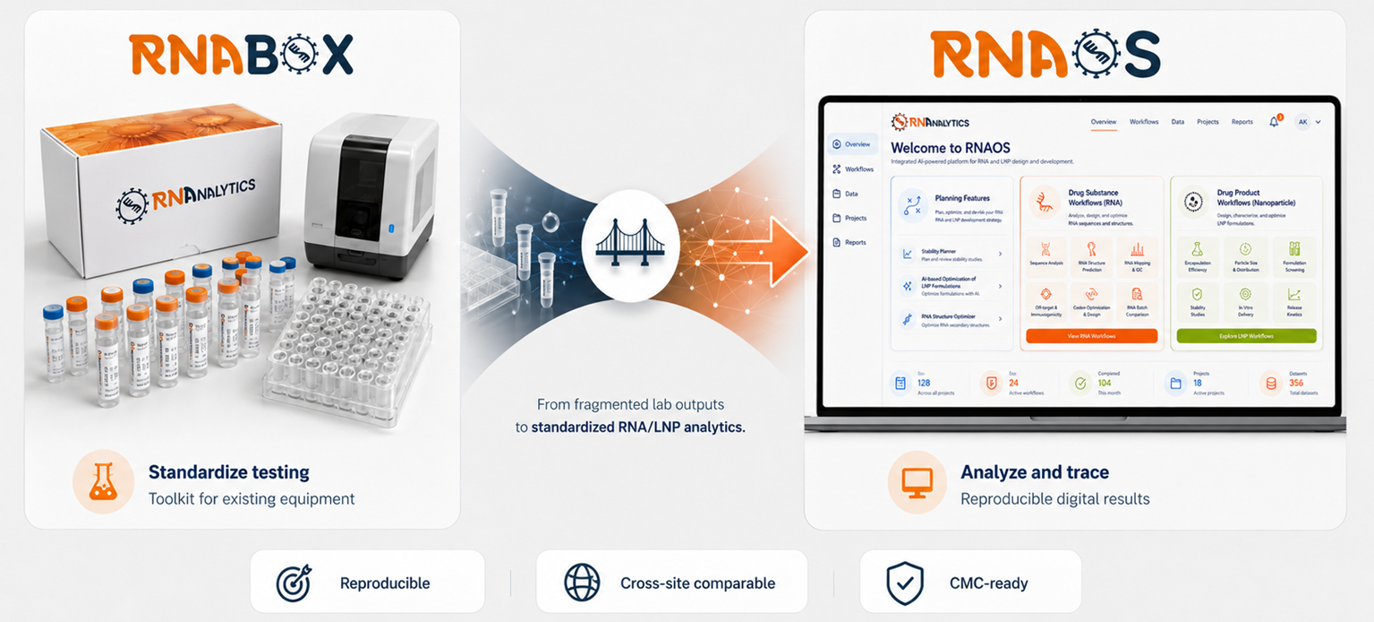
RNAOS connects program planning, assay-specific analysis, provenance, review and reporting in one modality-aware platform. GeneVectoAnalyzer standardizes the wet-lab workflow so results become reproducible, cross-site comparable and CMC-ready.

Instrument exports, calculations, specifications, review comments and reports live in separate systems. The result is manual joining, fragile reconstruction and slow transfer of analytical knowledge.
Instrument files, spreadsheets, email review and point tools break the chain from source data to final decision.
RNA, LNP, oligo and vector programs require different drug-substance, drug-product and stage-specific control logic.
Reruns, method transfer, CDMO handoff and quality review demand reconstructable records without slowing scientists down.
RNAOS does more than calculate results. It keeps the program context, analytical method, source file, calculation logic, review state and final evidence connected throughout the development lifecycle.

RNAOS captures modality, development stage and product architecture, then connects CMC planning to the analytical work that follows.

Supported source files or controlled numerical inputs feed versioned analytical logic across RNA, particles, oligos, formulation, sequencing and stability.

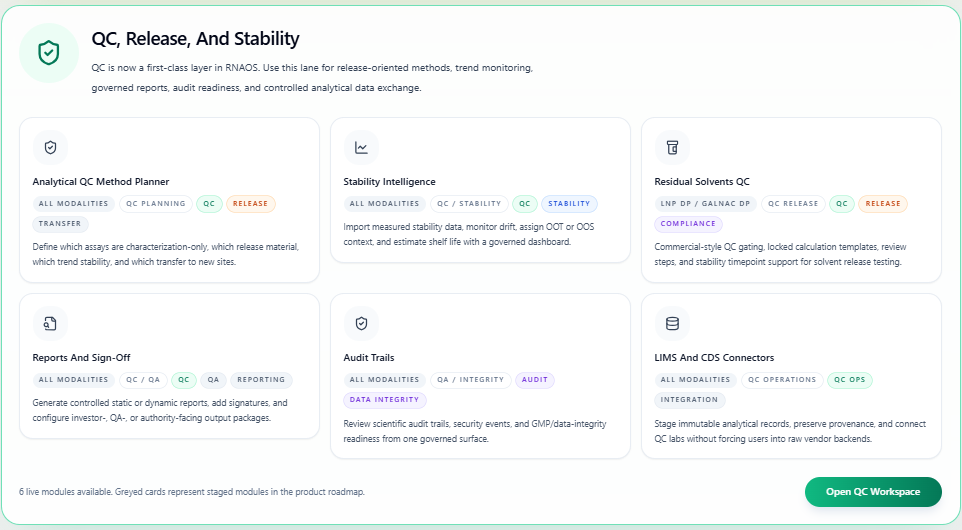
RNAOS preserves source identity, checksums, parameters, software and method versions, review state, corrections, signatures and audit evidence.

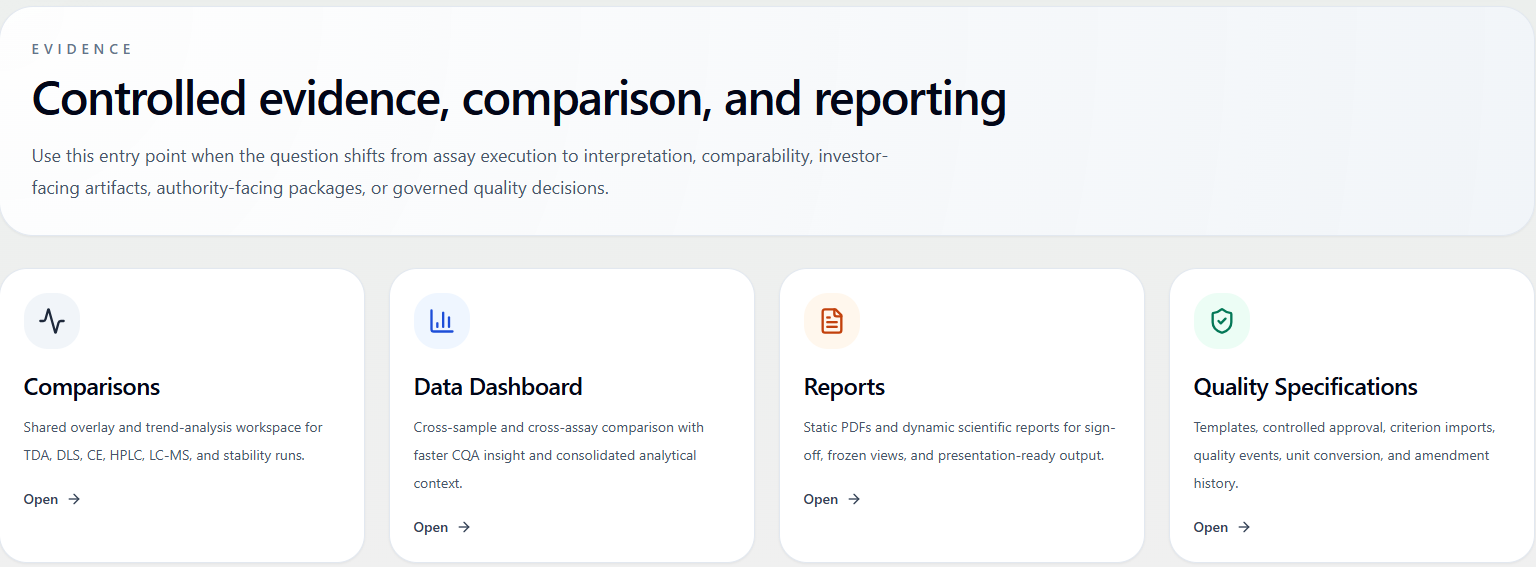
Compare assays, samples, lots, formulations and specifications in one evidence model—then generate reviewable outputs without losing provenance.
RNAOS combines modality-aware planning, analytical depth and governed workflow infrastructure. Start with one workflow and extend across assays, teams and development stages as your program grows.

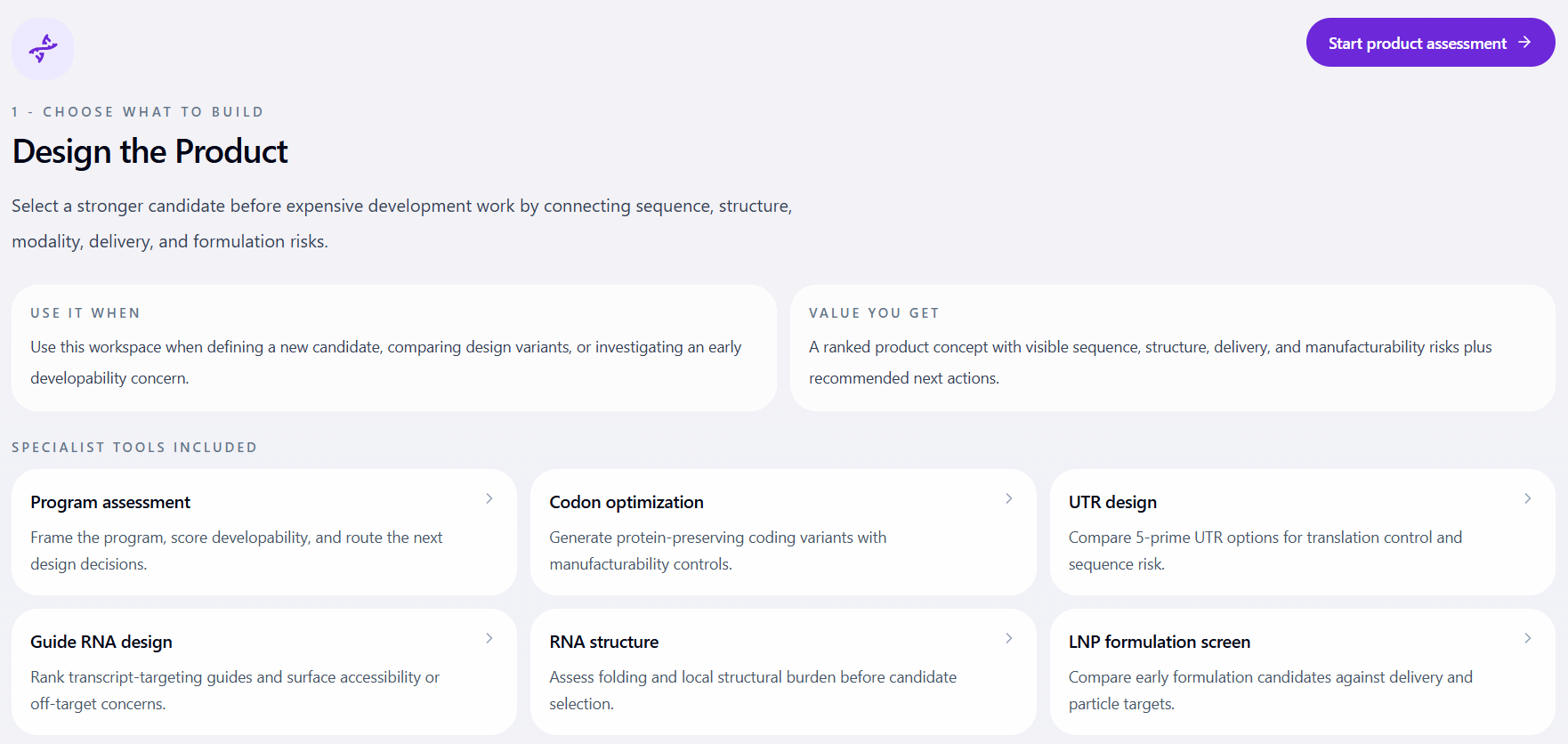
Developability, sequence, structure, formulation and early risk mapping before expensive development work.

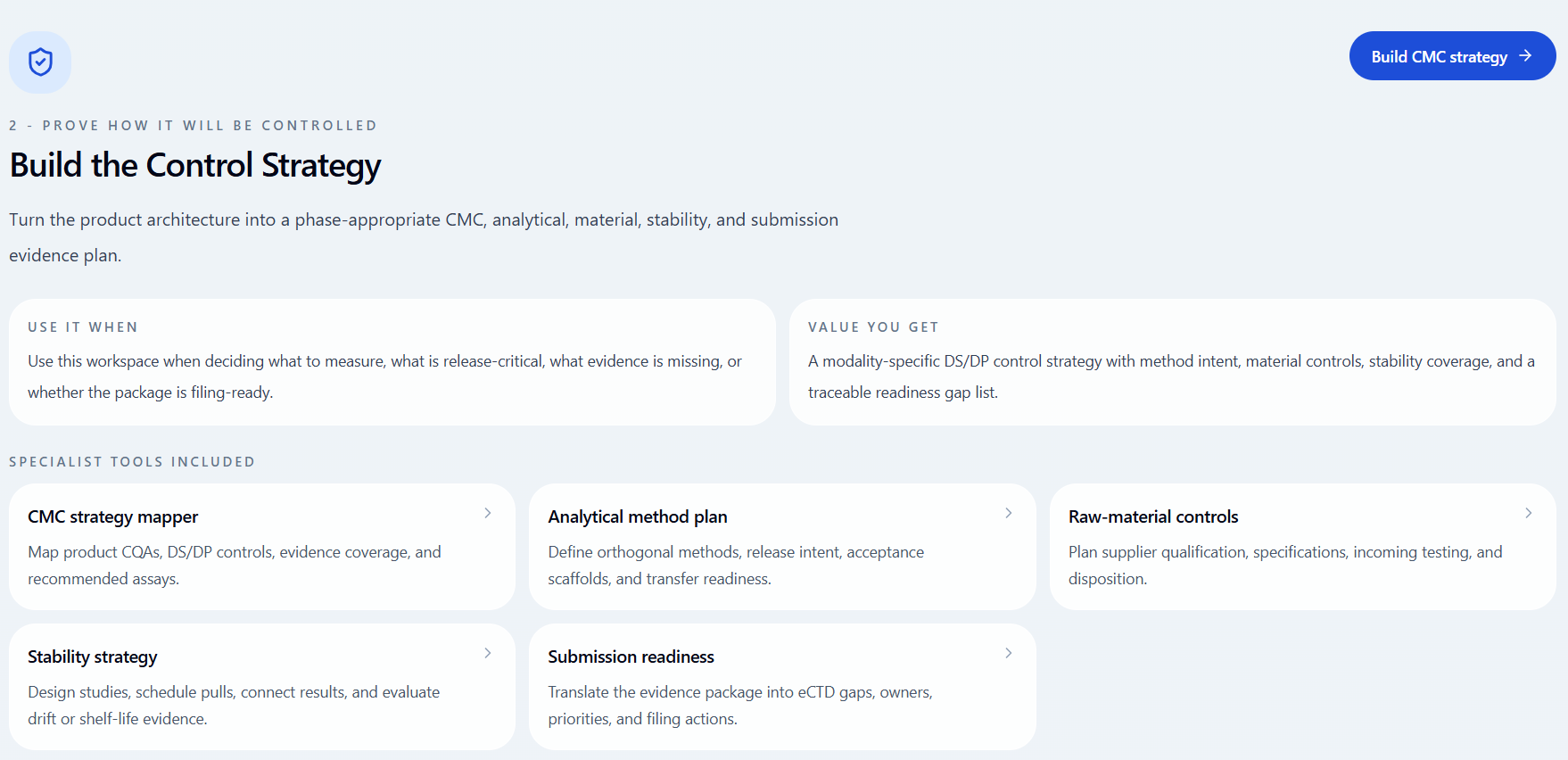
Map product CQAs, analytical methods, material controls, stability coverage and submission-readiness gaps.

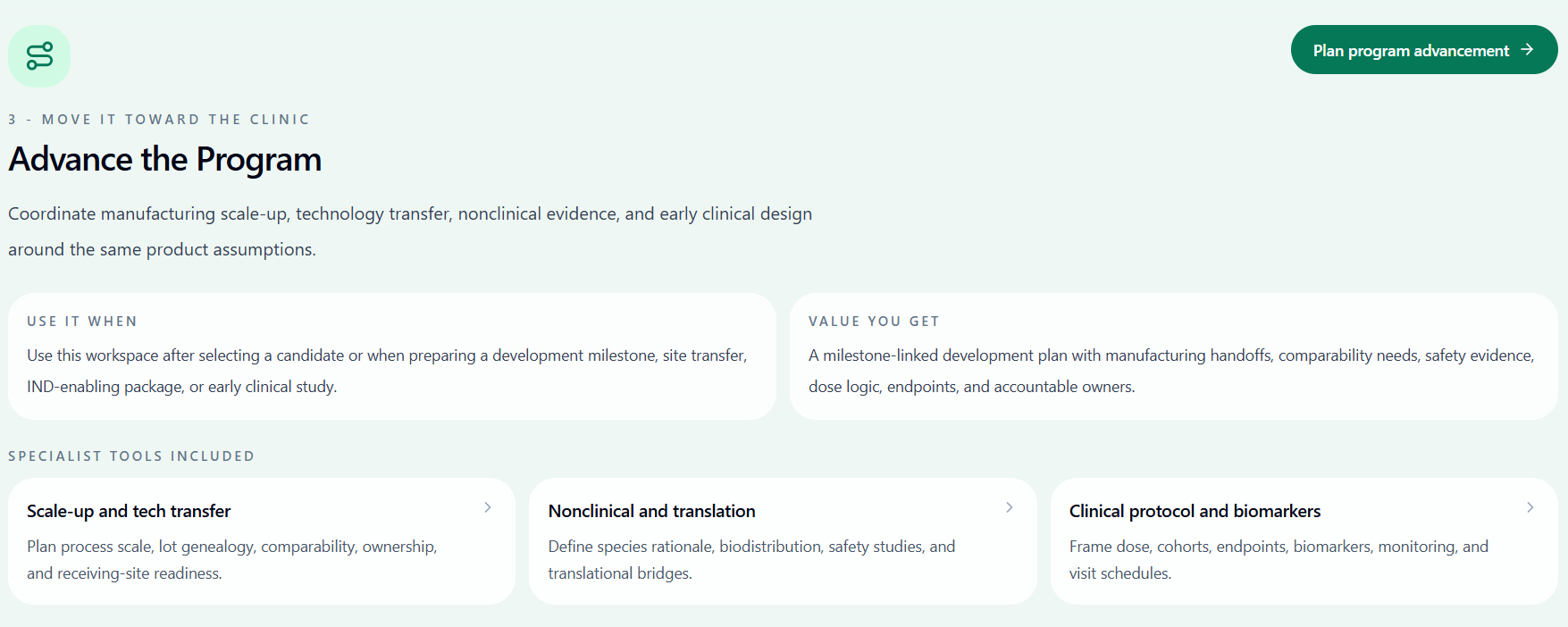
Coordinate scale-up, technology transfer, nonclinical evidence and early clinical design around shared product assumptions.

Use existing capillary electrophoresis infrastructure to generate high-resolution, reproducible nanoparticle measurements and connect the result directly into the RNAOS evidence workflow.
Orderable nowA typical 6–8 week pilot uses representative customer data and agreed success criteria to evaluate a real analytical workflow.
Taylor-dispersion analysis, multi-component fitting, hydrodynamic diameter, uncertainty and governed artifacts.
Total/free RNA inputs, fitted traces, AUC, RMSE, calculated EE and persistent workflow evidence.
Source files, peaks, metrics, algorithm version, governed record, review and reporting.
Chromatographic peaks, integrity metrics, evidence assessment and governed-record baseline.
Use your own representative data to prove shorter analyst-to-reviewer handoffs, defensible calculations, preserved provenance and faster report generation.
GeneVectoAnalyzer drives laboratory adoption. RNAOS expands through subscriptions, workflow credits, enterprise integrations and an accumulating canonical evidence layer.
RNAOS connects identity and access controls, provenance, versioned records, review, audit history, controlled storage and validation-support documentation in one analytical data path.

RNA analytics, product strategy, customer discovery and fundraising.

Operations, finance, unit economics and scalable delivery systems.

Software architecture, implementation and compliance-by-design.
Bring representative data and the workflow you want to improve. We will map the current process and propose a focused RNAOS pilot or GeneVectoAnalyzer configuration.